- English (UK)


Tesla Q1 26 Earnings Review: Beat on Numbers, Growth Under Pressure
.jpg?height=93&quality=100)
On April 22 after market close, Tesla reported its Q1 26 earnings. Revenue rose approximately 16% year-over-year, marking the strongest growth in nearly three years. Other key financial metrics—including earnings per share (EPS), gross margin, and operating income—came in well above expectations.
At the same time, despite rising capital expenditures, free cash flow unexpectedly turned positive, becoming one of the most closely watched highlights of the quarter.
However, in terms of market reaction, this “earnings beat” failed to translate into sustained momentum. The stock initially rose by as much as 4.5% following the release, but later retreated during the earnings call.
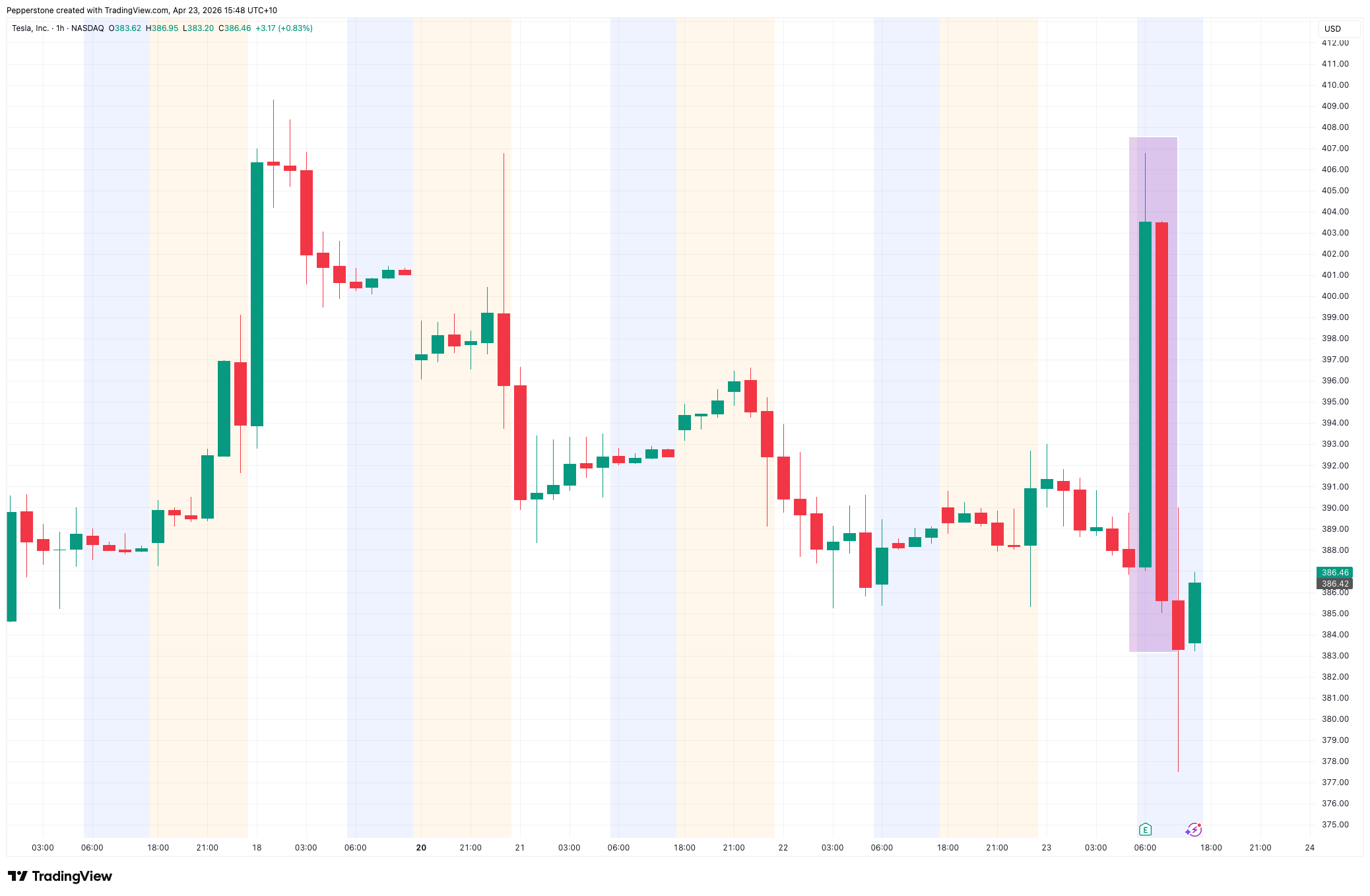
This shift essentially reflects two key concerns: first, the market is reassessing the sustained pressure that large-scale capital expenditure may place on future cash flows; second, it raises renewed doubts about the certainty of Tesla’s transition from a traditional automotive business toward an AI- and robotics-driven model.
Slowing Automotive Growth, Earnings Supported by Structural Strength
A key feature of this quarter is that profitability improvements were driven more by structural optimization than by business expansion. In other words, margins improved, but growth did not accelerate in parallel.
On the operational side, the automotive segment remains the core business but is clearly losing momentum. Deliveries in Q1 totaled approximately 358,000 units, up only about 6% year-over-year, below market expectations. Meanwhile, production exceeded deliveries by roughly 50,000 units, and inventory days increased to 27, signaling that demand recovery remains incomplete.
In contrast, automotive gross margins continued to recover. However, this improvement was not demand-driven, but rather the result of a “per-vehicle economics model”—where profitability is enhanced by software and services attached to each vehicle, rather than volume expansion alone.
From a revenue structure perspective, cost optimization also played a key role, supported by improved supply chain efficiency and lower raw material costs. High-margin services and other revenue grew approximately 42% year-over-year, while Full Self-Driving (FSD) subscription users increased about 51%, further strengthening software-driven profitability. In addition, foreign exchange effects and certain one-off items provided temporary support to earnings.
Overall, the key takeaway for the quarter is clear: vehicle growth is slowing, but profitability is being supported by structural upgrades and stronger software monetization, rather than a cyclical demand recovery.
AI and Robotics: Capex Upgrade and Pressure on Cash Flow Durability
Compared with already reported quarterly results, the market was more focused on forward guidance, with the earnings call serving as the key inflection point in sentiment.
A major driver of the stock’s reversal was Tesla’s decision to raise its FY2026 capital expenditure guidance to over $25 billion, significantly above prior expectations, while also signaling that free cash flow could turn negative again over the coming quarters.
The significance of this shift lies in the company’s increasingly concentrated allocation toward AI and robotics initiatives, including autonomous driving and Robotaxi networks, AI compute infrastructure, humanoid robots (Optimus), and related manufacturing and supply chain buildout. Strategically, Tesla is transitioning from a “technology validation phase” to a more capital-intensive pre-commercialization stage.
From a long-term perspective, these investments support the formation of a growth engine distinct from the automotive business. However, the near-term impact is equally clear: higher capital intensity reduces earnings and cash flow flexibility. As a result, the market has begun to reassess whether the current improvement in earnings and cash flow is sufficient to support a significantly more aggressive investment cycle ahead.
In the mismatch between committed investment and uncertain return timing, risk appetite has started to moderate, weighing on bullish momentum.
Earnings Recovery Confirmed, but Monetization Becomes the Real Test
Overall, this quarter confirms a recovery in profitability, while growth momentum remains incomplete.
More importantly, the results clearly highlight a “dual-track structure”: on one hand, the automotive business and software revenues provide a relatively stable earnings base; on the other hand, AI and robotics have become the central drivers of capital allocation and determine the company’s long-term upside.
As a result, Tesla is currently in a transitional phase where both its growth model and valuation framework are being redefined simultaneously.
In the short term, the market will focus on whether deliveries and inventory trends can stabilize together, and whether automotive margins remain sustainable after adjusting for one-offs. In the medium term, the trajectory of cash flow under rising capital expenditure will become the key constraint. In the long term, the pace of commercialization in AI and robotics will ultimately determine the ceiling of the company’s valuation.
Ultimately, this earnings report does not only answer where the company stands today in valuation terms—it raises a more important question: whether traders are still willing to pay a premium for a future that has not yet been fully realized.
The material provided here has not been prepared in accordance with legal requirements designed to promote the independence of investment research and as such is considered to be a marketing communication. Whilst it is not subject to any prohibition on dealing ahead of the dissemination of investment research we will not seek to take any advantage before providing it to our clients.
Pepperstone doesn’t represent that the material provided here is accurate, current or complete, and therefore shouldn’t be relied upon as such. The information, whether from a third party or not, isn’t to be considered as a recommendation; or an offer to buy or sell; or the solicitation of an offer to buy or sell any security, financial product or instrument; or to participate in any particular trading strategy. It does not take into account readers’ financial situation or investment objectives. We advise any readers of this content to seek their own advice. Without the approval of Pepperstone, reproduction or redistribution of this information isn’t permitted.